

Book a diagnostic call
What Are The Most Useful AI Tools?

What Are The Most Useful AI Tools?

1. Chatbots on the AI Frontier In the realm of AI, chatbots take the center stage. These tools engage with users in a conversational style, using advanced language models to answer queries, write code, and even perform calculations. Prominent chatbot solutions in 2023 include ChatGPT, Bard, and HuggingChat. ChatGPT, from the house of OpenAI, leads the pack with its impressive flexibility and user-friendly interface. Conversely, Bard, Google’s offering, aims for better accuracy and seamless integration with Google’s suite of products. Finally, HuggingChat is the open-source contender, backed by the collaborative AI platform, Hugging Face. 2. AI-Infused Content Creation Tools Battling with writer’s block? AI is here to break the deadlock. Tools like Jasper, Copy.ai, and Anyword can augment your writing process, turning you from a lone scribe into a powerful writing team. Jasper is a godsend for content-heavy users, with a plethora of templates and an in-built capability for research and image generation. On the other hand, Copy.ai is the perfect co-pilot for ideation, offering multiple writing options for each prompt. Lastly, Anyword streamlines content creation for marketers with its step-by-step approach to generate the final piece. 3. AI-Powered Text Enhancement Tools Beyond conventional spell-checking, AI brings a new dimension to text enhancement. Tools like Grammarly, Wordtune, and ProWritingAid can detect subtle nuances in tone and language, offering suggestions to make your writing clearer. Grammarly ensures language accuracy while also helping adjust tone and simplify complex phrases. Alternatively, Wordtune offers a plethora of wording alternatives, and ProWritingAid provides detailed grammar, style, and spelling statistics with a one-time lifetime plan. 4. AI Tools for Video Generation Video tools leveraging AI like Descript, Wondershare Filmora, and Runway offer features like background removal, noise reduction, and even AI-based frame painting. Descript revolutionizes video editing by enabling script-based editing, while Wondershare Filmora combines traditional video editing with AI enhancements. Runway, the video wizard, offers a suite of AI features for video generation and manipulation. 5. AI Applications for Image Generation Image generation tools like DALL·E 2, Midjourney, and DreamStudio (powered by Stable Diffusion) transform simple text prompts into stunning visuals. Whether you are an amateur or a pro, these tools can turn your imagination into vibrant pixels. 6. AI Note-taking Tools In the era of information overload, Mem is an AI tool that automatically tags and links your notes, making them easily retrievable when needed. This AI intervention ensures that no valuable piece of information gets lost in the abyss of notes. 7. AI Transcription and Meeting Assistant Apps AI transcription apps like Fireflies, Airgram, and Krisp convert voice to text, allowing you to focus on your meetings while the tool takes detailed notes. With AI data extraction and noise reduction features, these apps are truly a boon in the modern professional landscape. 8. AI Scheduling Applications AI can help streamline your schedule and prioritize your tasks. Tools like Reclaim, Clockwise, and Motion take the chore out of scheduling. Reclaim adjusts your schedule to ensure you hit your targets, Clockwise is a team-friendly tool promising time savings, and Motion aids in project management with AI-powered task scheduling. 9. AI Tools for Email and Inbox Management AI tools like SaneBox and EmailTree bring the much-needed organization to your cluttered inbox. They prioritize important messages, tag emails for easy retrieval, and automate replies, reducing your administrative load. 10. AI-Powered Presentation and Slide Deck Apps Creating a presentation that complements your stage presence is no small feat. However, with AI apps like Decktopus, Beautiful.ai, and Slidesgo, creating visually appealing presentations becomes a breeze. They generate presentations based on your inputs and offer customization options for a powerful final rendition. Each of these tools encapsulates the power of AI, turning the futuristic dream of AI-enhanced productivity into today’s reality. The rapid evolution of these tools, their increasing precision, and their seamless integration into our daily lives is a testament to the infinite potential of AI. This list is only the tip of the iceberg, and the AI universe has much more in store for us.

Read more
What Are The Biggest AI Trends in 2023

What Are The Biggest AI Trends in 2023?

The retail market is undergoing significant transformations due to rapid advancements in artificial intelligence (AI). Several reports predict a Compound Annual Growth Rate (CAGR) of 35% for global retail AI by 2026, a trend accelerated by the COVID-19 pandemic that caused a shift towards online platforms. AI and its Applications in the Retail Industry AI offers invaluable tools to streamline decision-making processes in key business areas such as marketing, e-commerce, and product management. Leveraging machine learning, an AI subset, commerce and retail sales can provide personalized and interactive experiences to consumers. IBM research predicts a surge in AI integration in commerce and manufacturing from 40% to 80% within the next three years. However, the reluctance of some corporations to adopt innovative solutions and the shortage of skilled employees in AI could present challenges for trend development. Key AI Trends in Retail for 2023 In the coming years, experts expect the domain of product optimization to significantly benefit from AI. As big data analytics continue to evolve, the adoption of AI-enabled devices and programs is expected to increase. Technological advancements are already underway with features like human speech processing, deep learning, and automated decision-making programs. The Consumer Technology Association emphasizes several benefits of AI implementation, including cost savings, increased productivity, quick decision-making, faster delivery of goods, and innovation growth, thus enhancing users’ analytics and behavioral experience. Case Studies in AI Implementation AI has already made its mark in various industries. For instance, Baker Hughes launched an AI-based application in 2020, enabling operators to access real-time production data, subsequently improving oil and gas production forecasts. The Global AI Retail Landscape North America is expected to dominate the AI market due to early adoption and significant investment in AI technologies. Global brands and corporations, such as NVIDIA, Intel, Salesforce, Microsoft, Google, IBM, and Amazon Web Services, are at the forefront of product optimization and development. Hyperautomation: The Future of AI and Machine Learning Hyperautomation, or digital/intellectual automation, involves applying innovative technologies to expedite and simplify tasks with minimal human intervention. This concept is particularly relevant in managing vast information flows and data analysis, making these tools increasingly accessible. Key professions in this field include application architects, machine learning specialists, data engineers, and enterprise architects. Hyperautomation employs technologies like Robotic Process Automation (RPA), Artificial Intelligence/Machine Learning (AI/ML), Cognitive Process Automation, and Intelligent Business Process Management Software (iBPMS). By integrating such technologies, businesses can streamline, design, and automate processes. The implementation of hyperautomation varies across industries. For instance, incorporating conversational AI and RPA in a company could improve customer support by automating responses to customer emails and enhancing customer satisfaction scores. Furthermore, integrating technology into labor-intensive processes can significantly boost productivity and reduce manual work. System integration allows businesses to seamlessly incorporate any digital technology into their workflows. Conclusion The AI revolution in the retail industry promises unprecedented changes in the way businesses operate. As the retail sector continues to embrace digital transformation, understanding and leveraging AI’s potential becomes increasingly important for staying competitive and driving growth in a rapidly evolving market.

Read more
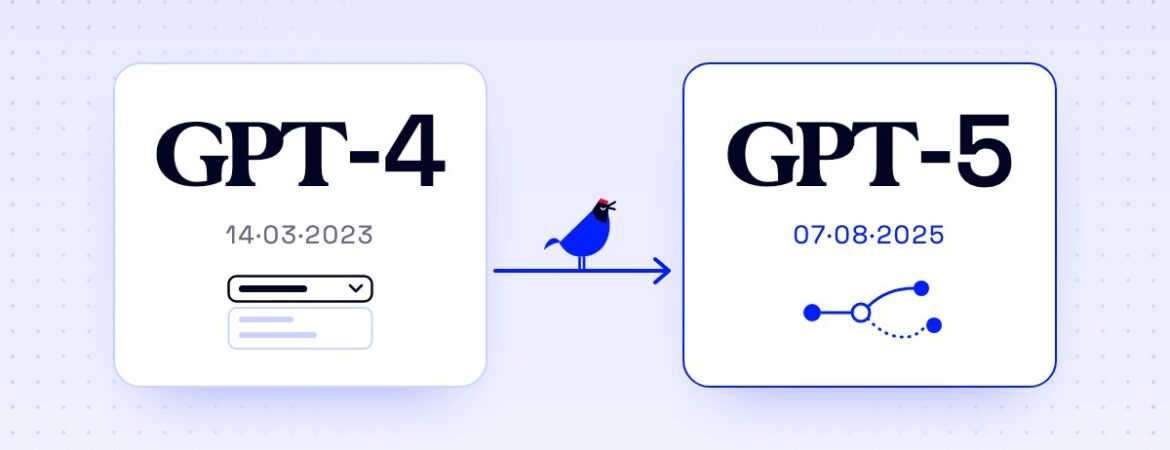
Comparison of GPT-4, released on 14 March 2023 with a model selector, and GPT-5, released on 7 August 2025 with a router that decides how much to reason.

What are the differences between Chat GPT-4 and Chat GPT-5?

There are two and a half years between them: GPT-4 was released on 14 March 2023, GPT-5 on 7 August 2025. And the main difference isn’t the usual one — “it reasons better” — but a change of concept: GPT-5 stopped being a model you choose and became a system that decides how much thinking each question needs. GPT-4 versus GPT-5: what changes for people who work with ChatGPT Aspect GPT-4 GPT-5 Release 14 March 2023 7 August 2025 How the model is chosen You pick it in ChatGPT's model selector. A router decides on each query whether to answer fast or reason longer; you can ask it to think harder. Context (API) 8,192 tokens. The 32,768 variant was limited-access and was retired in June 2025. 400,000 tokens: up to 272,000 in and 128,000 out. What OpenAI focuses on A multimodal model: it accepts text and images and is more reliable than GPT-3.5. A single system that combines fast answers and reasoning, with fewer hallucinations and better results in coding and tool-based tasks. Availability OpenAI shut it down on 23 October 2026. Current model, with later revisions. Source: OpenAI announcements, model documentation and deprecations page, checked on 11 October 2026. No benchmark figures: check those at the source. You no longer pick the model With GPT-4 and the models that followed, ChatGPT had a dropdown: you chose between the fast one, the one that reasoned, the one that read images. In practice hardly anyone knew which was right, and plenty of people used the worst model for their task without realising. GPT-5 took that decision out of the way. It is a system with a router that, depending on what you ask, either answers straight away or stops to reason first. For anyone using ChatGPT at work, that is the change you actually feel day to day — far more than any percentage in a technical report. What changes in practice Much longer texts in one go. GPT-4 started with a small context window and widened it with GPT-4 Turbo. GPT-5 works an order of magnitude above that: whole documents fit, not fragments. Code and chained tasks. This is where OpenAI focused this release, and where the difference shows most: following a long multi-step instruction, using external tools, and not losing the thread along the way. Fewer inventions. GPT-5 makes things up less often than GPT-4 and than the models in between. Less, not never: every figure, date and quote still has to be checked before it is published. More control from the API. You can tune how much effort it spends reasoning and how long its answers run, and there are smaller, cheaper versions for tasks that don’t need the big model. What didn’t change Both versions understand text and images. Both can be wrong with absolute confidence. And both depend on what you ask them: a badly written brief still produces a mediocre result on the best model on the market. One awkward thing didn’t change either: when OpenAI made GPT-5 the default and removed the dropdown, there was enough user pushback that it ended up restoring access to the earlier models on paid plans. Worth remembering before you build a company process on top of one specific model. The numbers, at the source We deliberately don’t quote benchmark percentages here. Models get revised every few months and those figures age fast; besides, laboratory results bear little resemblance to what you notice while working. If you need today’s numbers, they are in OpenAI’s GPT-5 announcement and its model documentation. GPT-4 shut down on 23 October 2026 This isn’t a theoretical comparison: OpenAI retired the gpt-4 model from its API on 23 October 2026, just as it had already retired the 32k variant in June 2025. If your company had anything in production calling that model by name, it stopped working that day. That is the practical argument for not tying a process to one specific model. What you fix is the task and how its output gets checked; whatever model sits underneath has to be swappable without redoing the work, because it does change — and, as we have just seen, on a published date. If you have to decide what to use in your company The useful question is almost never which model is best. It is which task you want off your plate, and whether its output can be checked. A repetitive task whose accuracy nobody can score cannot be automated safely, however good the model; and one that can be scored is often solved by a small, cheap model. That is what we do when we build AI agents wired into a client’s systems or automate internal processes: start from the task and how it gets measured, not from the model. Update, October 2026: this post was published in June 2023 and claimed GPT-5 had been released on 28 May 2023, with several performance figures attributed to that version. That was incorrect: GPT-5 did not exist on that date and the figures belonged to GPT-4. We have rewritten the article in full with the real information.

Read more
Why is Elon Musk Against AI?

Why is Elon Musk Against AI?

The Duality of AI According to Elon Musk In an enlightening interview with Tucker Carlson, tech mogul Elon Musk shared his perspective on artificial intelligence (AI), a subject that has sparked many a debate in the global tech community. Musk, the mind behind leading companies such as SpaceX and Tesla, expressed his concerns about the potential dangers posed by AI, cautioning that these threats could even lead to “civilization destruction”. Artificial Intelligence: A Double-Edged Sword The innovations in AI have proven to be groundbreaking, driving many of the technological advancements we see today. However, Musk warned that AI carries more risk than conventional technical errors like mismanaged aircraft design or faulty car production. Its potential for misuse, however small, could have catastrophic consequences on a civilizational scale. These warnings come at a time when AI products for consumer use are becoming increasingly common, with tech giants like Google and Microsoft at the forefront of this trend. However, Musk doesn’t merely express concerns — he’s been part of initiatives seeking to put checks on rampant AI development, including an open letter signed by several tech leaders calling for a temporary halt to the “out of control” race for AI development. The Need for Regulation in AI While the idea of regulatory measures in any field might not be thrilling, Musk highlighted the importance of such measures in the case of AI. He suggested that an initial group should be formed to understand AI, solicit industry opinions, and propose rule-making. According to Musk, waiting until AI is “in control” might make it too late to enforce effective regulations. Musk’s Investments in AI Despite his cautionary stance, Musk is no stranger to AI, having made significant contributions to its development through his various companies. For instance, Tesla heavily relies on AI, celebrating its achievements with an annual AI day. Musk was also a founding member of OpenAI, the company behind creations like ChatGPT. Although he expressed his disappointment with the current direction of OpenAI, Musk continues to harness AI for public benefit, intending to “use AI to detect & highlight manipulation of public opinion” on Twitter. Planning for a Truth-Seeking AI: TruthGPT Despite his initial involvement in OpenAI, Musk confessed to having “taken his eye off the ball,” creating an opening for Google and Microsoft to dominate the AI field. However, he revealed his intentions to compete against these tech giants by launching what he termed TruthGPT, a “maximum truth-seeking AI” aimed at understanding the universe. The Next Frontier for Musk in AI Reportedly, Musk is already laying the groundwork for a new venture, a generative AI startup aimed at rivaling OpenAI and ChatGPT. This endeavor will mark a new chapter in Musk’s journey with AI, a journey balancing the promise of technological advancement with the urgent need for caution and control. Elon Musk’s views on AI reflect a nuanced understanding of this powerful technology — recognizing its potential, while acknowledging the inherent risks. His balanced approach sets an example for the tech industry, showing how innovation can be married with responsible regulation to ensure the safe progression of AI technology.

Read more
Telegram Message us on WhatsApp