

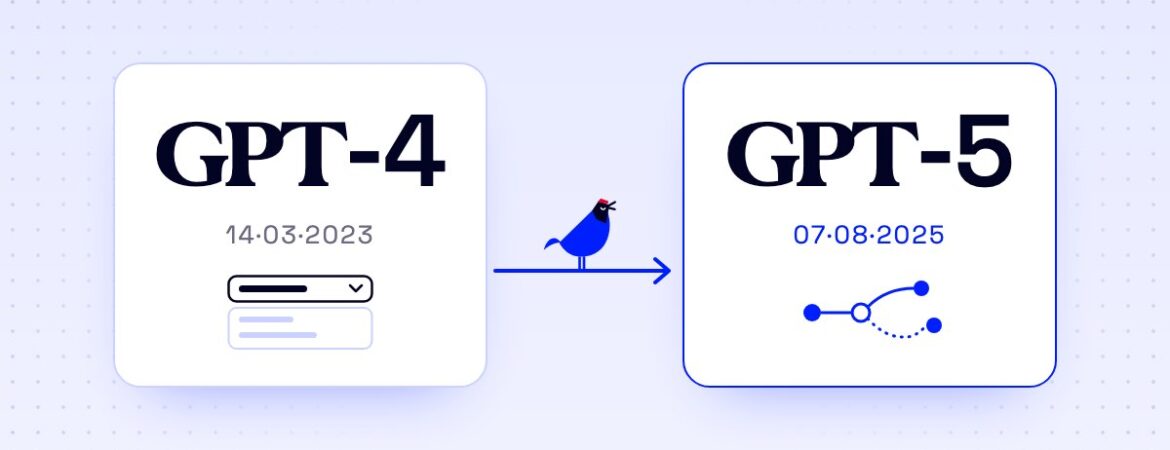
What are the differences between Chat GPT-4 and Chat GPT-5?
There are two and a half years between them: GPT-4 was released on 14 March 2023, GPT-5 on 7 August 2025. And the main difference isn’t the usual one — “it reasons better” — but a change of concept: GPT-5 stopped being a model you choose and became a system that decides how much thinking each question needs. GPT-4 versus GPT-5: what changes for people who work with ChatGPT Aspect GPT-4 GPT-5 Release 14 March 2023 7 August 2025 How the model is chosen You pick it in ChatGPT's model selector. A router decides on each query whether to answer fast or reason longer; you can ask it to think harder. Context (API) 8,192 tokens. The 32,768 variant was limited-access and was retired in June 2025. 400,000 tokens: up to 272,000 in and 128,000 out. What OpenAI focuses on A multimodal model: it accepts text and images and is more reliable than GPT-3.5. A single system that combines fast answers and reasoning, with fewer hallucinations and better results in coding and tool-based tasks. Availability OpenAI shuts it down on 23 October 2026. Current model, with later revisions. Source: OpenAI announcements, model documentation and deprecations page, checked on 11 October 2026. No benchmark figures: check those at the source. You no longer pick the model With GPT-4 and the models that followed, ChatGPT had a dropdown: you chose between the fast one, the one that reasoned, the one that read images. In practice hardly anyone knew which was right, and plenty of people used the worst model for their task without realising. GPT-5 took that decision out of the way. It is a system with a router that, depending on what you ask, either answers straight away or stops to reason first. For anyone using ChatGPT at work, that is the change you actually feel day to day — far more than any percentage in a technical report. What changes in practice Much longer texts in one go. GPT-4 started with a small context window and widened it with GPT-4 Turbo. GPT-5 works an order of magnitude above that: whole documents fit, not fragments. Code and chained tasks. This is where OpenAI focused this release, and where the difference shows most: following a long multi-step instruction, using external tools, and not losing the thread along the way. Fewer inventions. GPT-5 makes things up less often than GPT-4 and than the models in between. Less, not never: every figure, date and quote still has to be checked before it is published. More control from the API. You can tune how much effort it spends reasoning and how long its answers run, and there are smaller, cheaper versions for tasks that don’t need the big model. What didn’t change Both versions understand text and images. Both can be wrong with absolute confidence. And both depend on what you ask them: a badly written brief still produces a mediocre result on the best model on the market. One awkward thing didn’t change either: when OpenAI made GPT-5 the default and removed the dropdown, there was enough user pushback that it ended up restoring access to the earlier models on paid plans. Worth remembering before you build a company process on top of one specific model. The numbers, at the source We deliberately don’t quote benchmark percentages here. Models get revised every few months and those figures age fast; besides, laboratory results bear little resemblance to what you notice while working. If you need today’s numbers, they are in OpenAI’s GPT-5 announcement and its model documentation. GPT-4 shuts down on 23 October 2026 This isn’t a theoretical comparison: OpenAI has set that date to retire the gpt-4 model from its API, just as it already retired the 32k variant in June 2025. If your company has anything in production calling that model by name, it stops working that day. That is the practical argument for not tying a process to one specific model. What you fix is the task and how its output gets checked; whatever model sits underneath has to be swappable without redoing the work, because it will change. If you have to decide what to use in your company The useful question is almost never which model is best. It is which task you want off your plate, and whether its output can be checked. A repetitive task whose accuracy nobody can score cannot be automated safely, however good the model; and one that can be scored is often solved by a small, cheap model. That is what we do when we build AI agents wired into a client’s systems or automate internal processes: start from the task and how it gets measured, not from the model. Update, October 2026: this post was published in June 2023 and claimed GPT-5 had been released on 28 May 2023, with several performance figures attributed to that version. That was incorrect: GPT-5 did not exist on that date and the figures belonged to GPT-4. We have rewritten the article in full with the real information.


