

Book a diagnostic call

AI development

Will AI Be Able To Generate New Knowledge?

Will AI Be Able To Generate New Knowledge?

Artificial Intelligence (AI) is an increasingly influential sector encompassing algorithms and systems designed to perform tasks that would typically require human intelligence. AI is adept at processing large data volumes, recognizing patterns, predicting outcomes, and automating repetitive tasks. Despite AI’s ever-advancing capabilities, there are aspects, such as independent thought and creativity, that AI has yet to master and are crucial for scientific exploration and discovery. This article delves into AI’s limitations and the irreplaceable value of human curiosity in pushing the boundaries of science. By integrating the strengths of AI with human inquisitiveness, we can significantly enhance scientific research outcomes. The Limitations Of AI AI’s limitations stem from its inherent lack of creativity and independent thought. AI systems, fundamentally task-specific, fail to generate new ideas or develop unique solutions. This deficiency is especially notable when dealing with complex problems in scientific exploration and discovery. AI also struggles with posing questions and seeking novel knowledge. Unlike humans, AI lacks the capacity to be curious—an essential component in scientific exploration. While humans seek new knowledge through observation and questioning, AI is confined to processing predefined data. Understanding abstract concepts is another challenge for AI, due to the constraints of their training via specific datasets and algorithms. Humans, on the other hand, can work with and understand these abstract concepts—critical to advancing science. Despite AI’s impressive capabilities, these limitations hinder its contributions to scientific exploration and discovery. However, the combination of AI and human curiosity can spur advancements in scientific inquiry and discovery. The Role Of Human Curiosity In Scientific Advancement Human curiosity is the lifeblood of scientific progress and discovery. It fuels new ideas, propels research in new directions, and yields a steady flow of innovation and discovery. Throughout human civilization, curiosity has been the driver of scientific progress. This quest for understanding has led to countless innovations and discoveries, from the wheel’s invention to gravity laws, to modern medicine’s development. Curiosity is often the catalyst for new ideas and theories. It incites individuals to learn more about a subject, inspect it from various perspectives, and ask innovative questions. This engagement often results in new insights and theories. As a powerful motivator for research and development, curiosity propels individuals to devote time and effort to finding solutions. This commitment results in innovative approaches to research and development, which can redefine what is possible. The Benefits Of Combining AI And Human Curiosity AI systems can support human quests for knowledge by automating repetitive tasks and providing quicker, more accurate decision-making. AI algorithms can analyze large datasets, identify patterns, and make predictions that would be challenging or laborious for humans. This ability allows human researchers to focus on generating new hypotheses and developing new theories. Human curiosity can guide AI development by providing necessary context and direction. Researchers can use their world understanding to guide AI algorithms, ensuring they solve real-world problems and meet researchers’ needs. Human curiosity also identifies new AI applications and new areas of exploration, driving AI technology in novel directions. AI and human curiosity can work together to achieve greater results in scientific exploration and discovery. AI can compensate for human limitations, such as speed and accuracy, while human curiosity guides AI development and ensures its effective use. By combining AI’s strengths with human curiosity, researchers can attain a deeper understanding of complex problems, make informed decisions, and yield impressive scientific results. Conclusion Despite AI’s advances, human curiosity remains an essential element in scientific exploration and discovery. Human curiosity propels new ideas, inspires new research directions, and stimulates a steady innovation and discovery stream. To sustain scientific progress, we must continue to foster and nurture human curiosity. Combining AI with human curiosity can lead to remarkable results. While AI may eventually mimic certain aspects of human curiosity, curiosity is a fundamental human trait required for scientific progress. In the future, AI and human curiosity will operate in tandem to accomplish even more extraordinary scientific discoveries. While some argue that AI still needs to develop common sense, creativity, and a deeper world understanding, human curiosity propels researchers to ask questions, seek new knowledge, and explore fresh ideas, all essential for advancing AI research. Human expertise and creativity are crucial for developing effective responses to crises like the Covid-19 pandemic. While AI can replace some tasks, it cannot supplant human problem-solving skills. Thus, integrating the strengths of AI and human curiosity is vital for achieving exceptional results in scientific pursuits.
Read more
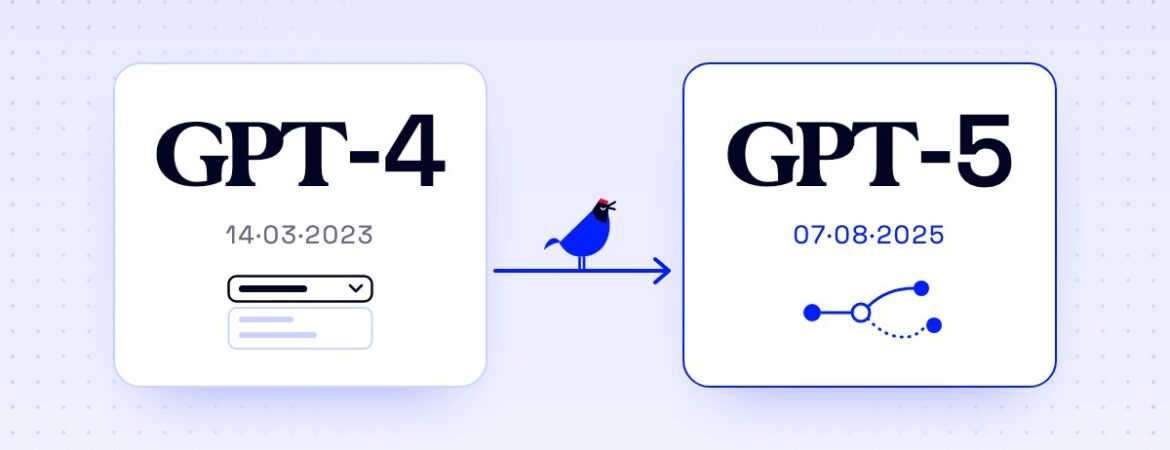
Comparison of GPT-4, released on 14 March 2023 with a model selector, and GPT-5, released on 7 August 2025 with a router that decides how much to reason.

What are the differences between Chat GPT-4 and Chat GPT-5?

There are two and a half years between them: GPT-4 was released on 14 March 2023, GPT-5 on 7 August 2025. And the main difference isn’t the usual one — “it reasons better” — but a change of concept: GPT-5 stopped being a model you choose and became a system that decides how much thinking each question needs. GPT-4 versus GPT-5: what changes for people who work with ChatGPT Aspect GPT-4 GPT-5 Release 14 March 2023 7 August 2025 How the model is chosen You pick it in ChatGPT's model selector. A router decides on each query whether to answer fast or reason longer; you can ask it to think harder. Context (API) 8,192 tokens. The 32,768 variant was limited-access and was retired in June 2025. 400,000 tokens: up to 272,000 in and 128,000 out. What OpenAI focuses on A multimodal model: it accepts text and images and is more reliable than GPT-3.5. A single system that combines fast answers and reasoning, with fewer hallucinations and better results in coding and tool-based tasks. Availability OpenAI shut it down on 23 October 2026. Current model, with later revisions. Source: OpenAI announcements, model documentation and deprecations page, checked on 11 October 2026. No benchmark figures: check those at the source. You no longer pick the model With GPT-4 and the models that followed, ChatGPT had a dropdown: you chose between the fast one, the one that reasoned, the one that read images. In practice hardly anyone knew which was right, and plenty of people used the worst model for their task without realising. GPT-5 took that decision out of the way. It is a system with a router that, depending on what you ask, either answers straight away or stops to reason first. For anyone using ChatGPT at work, that is the change you actually feel day to day — far more than any percentage in a technical report. What changes in practice Much longer texts in one go. GPT-4 started with a small context window and widened it with GPT-4 Turbo. GPT-5 works an order of magnitude above that: whole documents fit, not fragments. Code and chained tasks. This is where OpenAI focused this release, and where the difference shows most: following a long multi-step instruction, using external tools, and not losing the thread along the way. Fewer inventions. GPT-5 makes things up less often than GPT-4 and than the models in between. Less, not never: every figure, date and quote still has to be checked before it is published. More control from the API. You can tune how much effort it spends reasoning and how long its answers run, and there are smaller, cheaper versions for tasks that don’t need the big model. What didn’t change Both versions understand text and images. Both can be wrong with absolute confidence. And both depend on what you ask them: a badly written brief still produces a mediocre result on the best model on the market. One awkward thing didn’t change either: when OpenAI made GPT-5 the default and removed the dropdown, there was enough user pushback that it ended up restoring access to the earlier models on paid plans. Worth remembering before you build a company process on top of one specific model. The numbers, at the source We deliberately don’t quote benchmark percentages here. Models get revised every few months and those figures age fast; besides, laboratory results bear little resemblance to what you notice while working. If you need today’s numbers, they are in OpenAI’s GPT-5 announcement and its model documentation. GPT-4 shut down on 23 October 2026 This isn’t a theoretical comparison: OpenAI retired the gpt-4 model from its API on 23 October 2026, just as it had already retired the 32k variant in June 2025. If your company had anything in production calling that model by name, it stopped working that day. That is the practical argument for not tying a process to one specific model. What you fix is the task and how its output gets checked; whatever model sits underneath has to be swappable without redoing the work, because it does change — and, as we have just seen, on a published date. If you have to decide what to use in your company The useful question is almost never which model is best. It is which task you want off your plate, and whether its output can be checked. A repetitive task whose accuracy nobody can score cannot be automated safely, however good the model; and one that can be scored is often solved by a small, cheap model. That is what we do when we build AI agents wired into a client’s systems or automate internal processes: start from the task and how it gets measured, not from the model. Update, October 2026: this post was published in June 2023 and claimed GPT-5 had been released on 28 May 2023, with several performance figures attributed to that version. That was incorrect: GPT-5 did not exist on that date and the figures belonged to GPT-4. We have rewritten the article in full with the real information.

Read more
Why is Elon Musk Against AI?

Why is Elon Musk Against AI?

The Duality of AI According to Elon Musk In an enlightening interview with Tucker Carlson, tech mogul Elon Musk shared his perspective on artificial intelligence (AI), a subject that has sparked many a debate in the global tech community. Musk, the mind behind leading companies such as SpaceX and Tesla, expressed his concerns about the potential dangers posed by AI, cautioning that these threats could even lead to “civilization destruction”. Artificial Intelligence: A Double-Edged Sword The innovations in AI have proven to be groundbreaking, driving many of the technological advancements we see today. However, Musk warned that AI carries more risk than conventional technical errors like mismanaged aircraft design or faulty car production. Its potential for misuse, however small, could have catastrophic consequences on a civilizational scale. These warnings come at a time when AI products for consumer use are becoming increasingly common, with tech giants like Google and Microsoft at the forefront of this trend. However, Musk doesn’t merely express concerns — he’s been part of initiatives seeking to put checks on rampant AI development, including an open letter signed by several tech leaders calling for a temporary halt to the “out of control” race for AI development. The Need for Regulation in AI While the idea of regulatory measures in any field might not be thrilling, Musk highlighted the importance of such measures in the case of AI. He suggested that an initial group should be formed to understand AI, solicit industry opinions, and propose rule-making. According to Musk, waiting until AI is “in control” might make it too late to enforce effective regulations. Musk’s Investments in AI Despite his cautionary stance, Musk is no stranger to AI, having made significant contributions to its development through his various companies. For instance, Tesla heavily relies on AI, celebrating its achievements with an annual AI day. Musk was also a founding member of OpenAI, the company behind creations like ChatGPT. Although he expressed his disappointment with the current direction of OpenAI, Musk continues to harness AI for public benefit, intending to “use AI to detect & highlight manipulation of public opinion” on Twitter. Planning for a Truth-Seeking AI: TruthGPT Despite his initial involvement in OpenAI, Musk confessed to having “taken his eye off the ball,” creating an opening for Google and Microsoft to dominate the AI field. However, he revealed his intentions to compete against these tech giants by launching what he termed TruthGPT, a “maximum truth-seeking AI” aimed at understanding the universe. The Next Frontier for Musk in AI Reportedly, Musk is already laying the groundwork for a new venture, a generative AI startup aimed at rivaling OpenAI and ChatGPT. This endeavor will mark a new chapter in Musk’s journey with AI, a journey balancing the promise of technological advancement with the urgent need for caution and control. Elon Musk’s views on AI reflect a nuanced understanding of this powerful technology — recognizing its potential, while acknowledging the inherent risks. His balanced approach sets an example for the tech industry, showing how innovation can be married with responsible regulation to ensure the safe progression of AI technology.

Read more
What are the 7 main areas of AI?

Decoding the Seven Types of Artificial Intelligence

Artificial Intelligence (AI) has seamlessly integrated into our lives, thanks to advanced technologies like Amazon’s Alexa, Apple’s Face ID, and sophisticated chatbots. The burgeoning field of AI continues to evolve with discoveries and developments in different types, each presenting a unique storyline about AI’s progress and future potential. Let’s delve into the seven key types of AI and what we can expect from them. Capability-Based AI Types AI can be categorized into three key types based on their learning capabilities and knowledge application: Artificial Narrow Intelligence (ANI), Artificial General Intelligence (AGI), and Artificial Superintelligence (ASI). Artificial Narrow Intelligence (ANI) ANI, or Narrow AI, is designed for executing specific tasks. This AI excels in a particular cognitive capability but can’t independently learn skills outside its design. Examples include image recognition software, self-driving cars, and virtual assistants like Siri. Artificial General Intelligence (AGI) AGI, or Strong AI, emulates human intelligence, learning, and thinking capabilities. AGI aspires to create multifunctional AI machines that can assist humans in everyday tasks. The groundwork for AGI can be built from technologies like supercomputers, quantum hardware, and generative AI models like ChatGPT. Artificial Superintelligence (ASI) ASI, or Super AI, surpasses human intelligence and learning capabilities, often seen in sci-fi. ASI paves the way for self-aware AI and independent robots, fueling popular tropes like AI takeovers. However, currently, ASI remains a speculative concept. Functionality-Based AI Types AI can also be classified into four types based on functionality: Reactive Machines, Limited Memory, Theory of Mind, and Self-Aware AI.  Reactive Machines Reactive Machines, the most fundamental type of AI, respond to immediate requests and tasks. Their usage ranges from spam filtering to recommending movies, but they lack memory or learning capabilities. Limited Memory AI Limited Memory AI represents the next step in AI evolution, capable of storing past data and making predictions. This AI category forms the majority of AI applications today, from chatbots to self-driving cars. Theory of Mind AI Theory of Mind AI, a concept yet to be fully realized, is an AI that can perceive and respond to emotional cues, akin to human empathy. However, despite its promising benefits, this AI category may pose risks due to the complexities of understanding nuanced emotional cues. Self-Aware AI Self-Aware AI, which attains self-awareness, marks the AI point of singularity. The creation of self-aware AI is a future with potential promise and danger, sparking debates about the ethics of sentient AI creation. Despite the possible concerns, we are still far from self-aware AI becoming a reality. Conclusion Understanding the seven types of AI provides insight into the current state of AI and its future trajectory. As the field continues to progress, so does the exciting potential of artificial intelligence to revolutionize our world.

Read more
Telegram Message us on WhatsApp